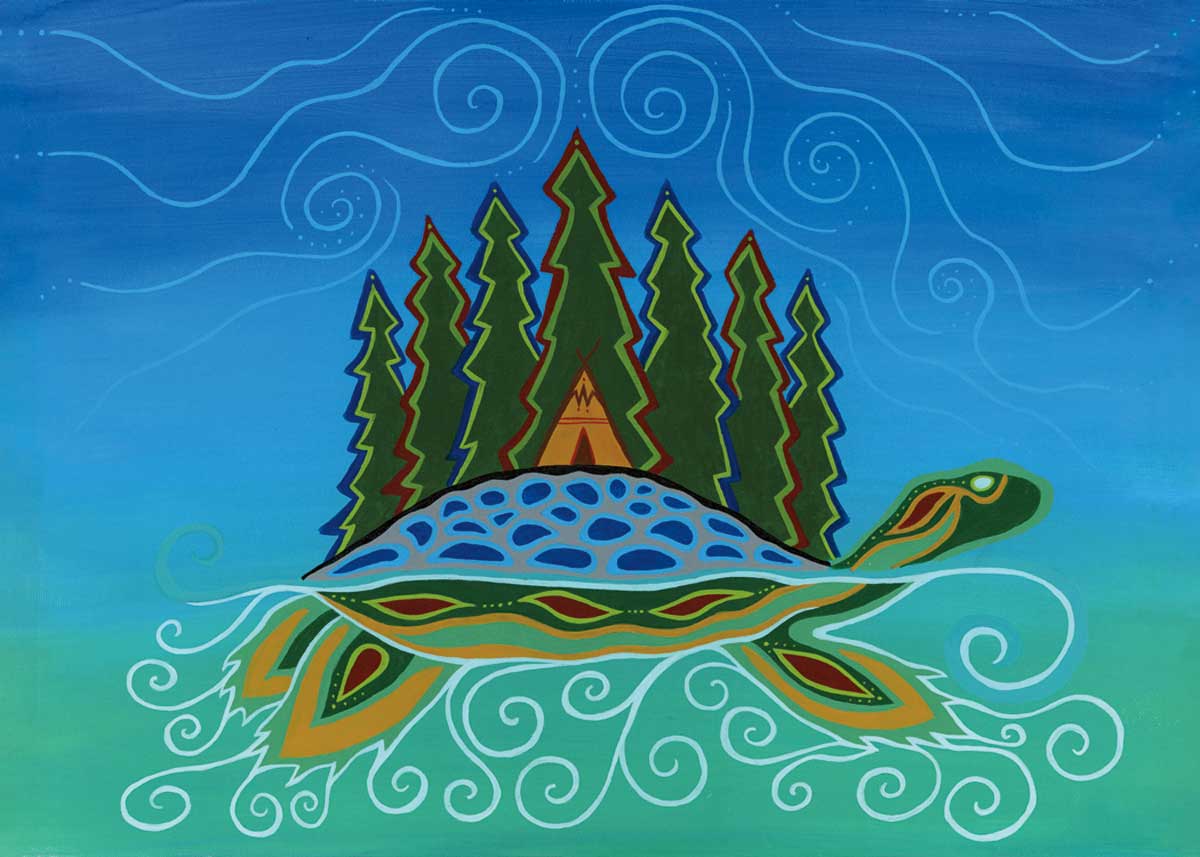
Image credit: ‘Turtle Island Magnet’ by Patrick Hunter
This timeline aims to illustrate a brief historical overview of Indigenous history in North American
Canada
Settlers claim “manifest destiny” for North American expansion.
“Manifest destiny” was the idea that white Americans were entitled to settle in North America, and this ideology included measures that removed and destroyed the Native population.
Mohawk Residential School
The first church-run Indian Residential School.
The Gradual Civilization Act
This act sought to assimilate Indigenous peoples by encouraging enfranchisement and adherence to the European concept of private land ownership and wealth accumulation.
https://www.thecanadianencyclopedia.ca/en/article/gradual-civilization-act
British North America Act
Canada became a country but remained a
colony of the British Empire. The Act provided the basic governmental structures and laws by which Canada would govern its people. One section in particular – section 91(24) – defined the relationship between the government and Aboriginal Peoples, echoes of which continues to define the relationship to this day. This set the stage for the Indian act.
Indian Act
In effect, it obstructed the celebration of powwows by restricting Indigenous peoples’ right to conduct cultural and spiritual ceremonies and wear traditional outfits.
Potlatch ceremony banned
“Recognized as integral to the culture of coastal First Nations, the potlatch was targeted with particular force.”
https://www.ictinc.ca/blog/the-potlatch-ban-abolishment-of-first-nations-ceremonies
Indian Act amendment
The 1876 Indian Act obstructed the celebration of powwows by restricting Indigenous peoples’ right to conduct cultural and spiritual ceremonies and wear traditional outfits. Including the sun dance an annual sacred ceremony performed by several First Nations in the Prairies.
Order that labelled dancing and ceremonies “Indian Offences”
Despite these restrictions, the first nations continued to hold powwows.
Special Joint Committee of the Senate and House of Commons to hear various reports on Indigenous life
Another amendment to the Act in 1951, allowing First Nations to continue their traditional ceremonies, including powwows, without interference by the federal government
The Indian Act also gave the provincial government authority over Indigenous child welfare… see the sixties scoop below
Beginning of the Sixties Scoop
The forced removal of First Nations, Metis and Inuit children from their homes, and placement in non-Indigenous families
http://www.revparl.ca/english/issue.asp?param=83&art=255
National Indian Brotherhood’s report Indian Control over Indian Education published, inspiring Aboriginal leaders to take control of social services
Some Aboriginal leaders, including Secwepemc leader Wayne Christian, helped draw attention to the disproportionately high number of Aboriginal children apprehended by child welfare services and to the need to act.
Powwow had become extremely popular and even commercial
Example of how Powwow became commercial:
https://www.canab.com/mainpages/events/powwow_files/award_categories.html
Section 25 of the Charter and Section 35 of the Constitution Act, 1982
Recognizes and affirms the constitutional rights of Indigenous peoples in Canada. This includes but is not limited to enforcing treaties and Aboriginal land titles, and the right to preserve traditional cultural practices and activities such as fishing, logging, hunting and other customary and sacred traditions.
The Canadian Council on Social Development commissioned Patrick Johnston to undertake the first comprehensive statistical overview of Aboriginal child welfare
The results showed that Aboriginal children were consistently overrepresented in child welfare services.
Justice Edwin Kimelman releases No Quiet Place: Review Committee on Indian and Metis Adoptions and Placements, which is a critical review of Aboriginal child apprehension
In this report, popularly known as The Kimelman Report, Kimelman and his committee, after holding hearings and listening to oral testimony, made 109 recommendations for policy change. Kimelman concluded that “cultural genocide has taken place in a systematic, routine manner.”
Last residential school closed
The Gordon Residential School in Punnichy, Saskatchewan, closed in 1996. It was the last federally-funded residential school in Canada.
First National Indigenous Peoples Day
National Aboriginal Day, now National Indigenous Peoples Day, was announced in 1996 by then Governor General of Canada, Roméo LeBlanc, through the Proclamation Declaring June 21 of Each Year as National Aboriginal Day.
https://www.rcaanc-cirnac.gc.ca/eng/1100100013718/1708446948967
United Nations Declaration on the Rights of Indigenous Peoples (UNDRIP)
Endorsed by the Government of Canada in 2010, UNDRIP provides an internationally recognized framework for measuring the human rights of Indigenous peoples, setting the “minimum standards for the survival, dignity and well-being of the Indigenous peoples of the world.”[524] Several provisions directly relate to rights associated with practicing Indigenous Spirituality.
Truth and Reconciliation Commission began investigation
More information on Truth and Reconciliation Commission could be found on this link: https://www.rcaanc-cirnac.gc.ca/eng/1450124405592/1529106060525
Public apology to Aboriginal Peoples acknowledging Canada’s role in the Indian Residential Schools system
Check full Apology Letter using this link: https://www.rcaanc-cirnac.gc.ca/eng/1100100015644/1571589171655
Rights of Passage Exhibition at the Canadian Museum for Human Rights
Link to the Website: https://humanrights.ca/exhibitions-and-events/past-exhibitions#:~:text=Rights%20of%20Passage-,December%202017%20to%20March%202019,and%20freedoms%2C%20justice%20and%20equality.
Unveiling of St. Joseph Indian Residential School Memorial Site
Ceremony revealing the name of 2,800 children who died in Indian residential schools at the Canadian Museum Quebec
https://cbc.ca/news/canada/north/residential-school-deaths-ceremony-1.5304139
Indigenous communities have moved powwows to the internet
In late March, an Indigenous dance movement, the Social Distance Powwow, was born. Like many Indigenous traditions, the movement was born out of necessity. Originally started on Facebook, the group formed due to strict social distancing measures imposed in many Indigenous communities.
https://www.vox.com/first-person/2020/6/17/21292945/coronavirus-native-americans-pow-wow-indigenous-peoples
Lake Nipissing Beading Project
This community collaborative project is meant to bring folks from Nipissing and Dokis communities together through a shared project, as well as other Turtle Island individuals and communities to bead a portion of the lake and its surrounding waterways. We bead to show respect and acknowledge the importance of this waterway to those across this continent, we are all connected and the water shows us this.
Link: https://www.lakenipissingbeadingproject.com/
First National Truth and Reconciliation Day (Orange Shirt Day)
This community collaborative project is meant to bring folks from Nipissing and Dokis communities together through a shared project, as well as other Turtle Island individuals and communities to bead a portion of the lake and its surrounding waterways. We bead to show respect and acknowledge the importance of this waterway to those across this continent, we are all connected and the water shows us this.
Link: https://www.lakenipissingbeadingproject.com/
Discovery of unmarked burial sites associated with former residential schools in British Columbia, Saskatchewan and Manitoba.
The Penelakut Tribe in B.C.’s Southern Gulf Islands says it has found more than 160 “undocumented and unmarked” graves in the area, which was also once home to the Kuper Island Residential School.
Link: https://www.cbc.ca/news/canada/british-columbia/penelakut-kuper-residential-school-1.6100201
The Residential Schools Missing Children Community Support Fund
Ottawa launched the Residential Schools Missing Children Community Support Fund in June 2021. The money is for communities and families to research, locate and document burial sites, as well as to memorialize the deaths of children and return remains home.
Pope Francis’ apology to Indigenous Peoples in Canada
Indian Residential School Memorial Monument by Kwakwaka’waka artist Stanely C.Hunt
Dates
1819
1820
1830
1831
1857
1860
1867
1876
1878
1879
1883
1884
1885
1887
1895
1928
1946
1951
1958
1972
1978
1980
1983
1985
1996
2007
2008
2017
2019
2020
2021
2022
2024
United States
Indian Civilization Act
Implemented with the purpose of providing protection against further decline and the final extinction of the Indian tribes. This act led to the establishment of Indian Boarding Schools.
https://www.thecanadianencyclopedia.ca/en/timeline/the-indian-act
Settlers claim “manifest destiny” for North American expansion.
“Manifest destiny” was the idea that white Americans were entitled to settle in North America, and this ideology included measures that removed and destroyed the Native population.
Indian Removal Act
Authorized the president to grant lands west of the Mississippi in exchange for Native American lands.
https://history.state.gov/milestones/1830-1860/indian-treaties
First on-reservation boarding school
In 1860 the Bureau of Indian Affairs established the first on-reservation boarding school on the Yakima Indian Reservation in Washington
https://www.theindigenousfoundation.org/articles/us-residential-schools
Ban on Native Dancing
U.S. Secretary of Interior Henry M. Teller bans “heathenish dances” on reservations for their “great hinderance to civilization.”
Boarding School Policy instated
The U.S. government forcibly removed Native children from their families and tribes and placed them in residential boarding schools apart from their culture. Military schools restrict children from
contacting family and push them to learn Christianity, English, and Euro-American traditions and customs.
Carlisle Indian School
The first government-run Indian Boarding School in the US.
Religious Crimes Code
Congress bans Native dancing and ceremonies, such as the Sun Dance, Ghost Dance, potlaches, and the practices of medicine persons.
Daws Act
An Act was passed to provide for the allotment of lands in severalty to Indians on the various reservations and to extend the protection of the laws of the United States and the Territories over the Indians and other purposes. In essence it regulated land rights on tribal territories within the United States.
Meriam Report
Report on the conditions of Native Americans in twenty-six states. The first one [on Native American conditions] since the 1850s.
The Indian Adoption Project
The forced removal of Indigenous children from reservations and the promotion of adoption of Indigenous children into non-Native families.
Indian Child Welfare Act
The Indian Child Welfare Act (ICWA) of 1978 is a Federal law that governs the removal and out-of-home placement of American Indian and Alaska Native (AI/AN) children and youth. The law was enacted after the Federal Government recognized that AI/AN children and youth were being removed from their homes and communities at a severely disproportionate rate compared to non-AI/AN children and youth
https://www.childwelfare.gov/topics/tribal-child-welfare/indian-child-welfare-act/?top=1390
Powwow had become extremely popular and even commercial
Example of how Powwow became commercial:
https://www.canab.com/mainpages/events/powwow_files/award_categories.html
United Nations Declaration on the Rights of Indigenous Peoples (UNDRIP)
Endorsed by the Government of Canada in 2010, UNDRIP provides an internationally recognized framework for measuring the human rights of Indigenous peoples, setting the “minimum standards for the survival, dignity and well-being of the Indigenous peoples of the world.”[524] Several provisions directly relate to rights associated with practicing Indigenous Spirituality.
Indigenous communities have moved powwows to the internet
In late March, an Indigenous dance movement, the Social Distance Powwow, was born. Like many Indigenous traditions, the movement was born out of necessity. Originally started on Facebook, the group formed due to strict social distancing measures imposed in many Indigenous communities.
https://www.vox.com/first-person/2020/6/17/21292945/coronavirus-native-americans-pow-wow-indigenous-peoples
 Stolen Lives