Our class is a living testimony to the power of storytelling and dedication to social justice. It also testifies to experiential teaching and learning within and beyond the class-room walls. We are a team of internationally diverse students hailing from unique cultural and social backgrounds and identifying with a variety of genders. Our shared passion to be a part of positive change informed our collaborations with Algoma University and each other, steered the course throughout the term, and fuels this narrative.
We set out to uncover narratives of Indigenous children displaced by the Indian Boarding Schools, Foster Care, and Adoption systems. Our goal was twofold and straightforward. First, to explore the legacies of complex and often tragic histories. Second, to share our new knowledge and lingering questions with local and global communities.
From the beginning, we integrated arts-based research, community participation, class discussions and debates, and public with private reflections. With Professor Mykoff’s guidance and the varied viewpoints of our classmates, we sensitively and purposefully traversed the historical landscapes in Canada and the U.S. Our journey happened within safe spaces, ranging from the classroom in the Netherlands to the welcome center and ceremony at Algoma University.
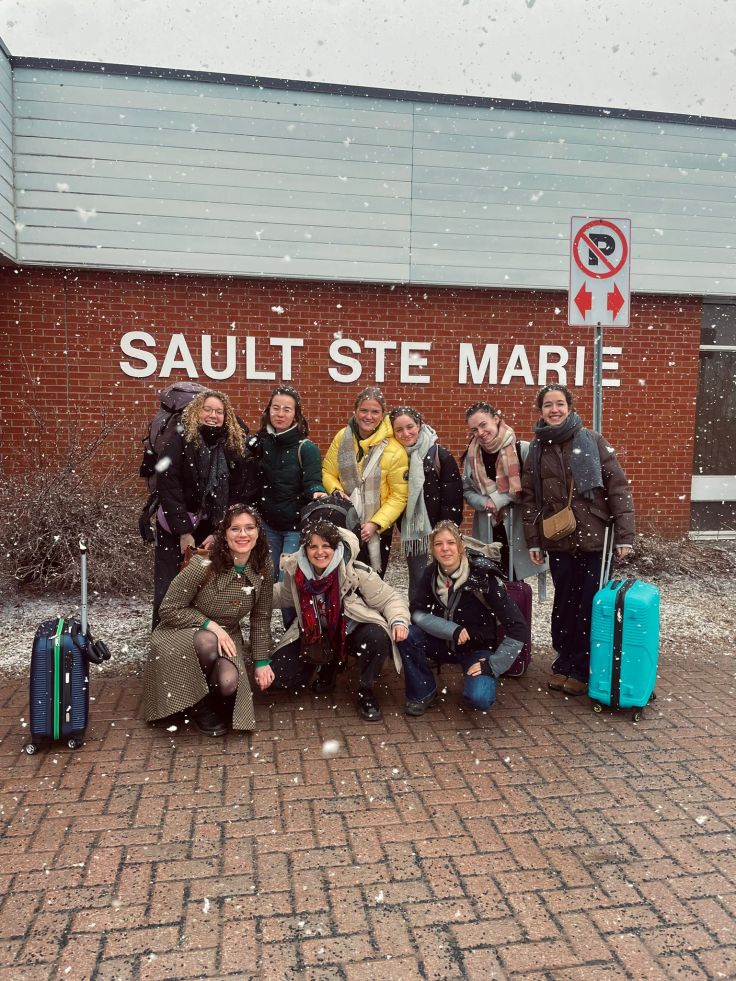
Deliberately examining the lives disrupted and identities shattered by structural injustices, our journey across time spanned the nineteenth through the twenty-first centuries. We established relationships with Native Canadian scholars, survivors, and elders as we explored the tragic histories of Canada’s Shingwauk Indian Residential School in Sault Ste. Marie. The field trips to Sault Ste. Marie’s Algoma University and Amsterdam’s MEZRAB center were life-changing. They allowed us to comprehend Indigenous histories better and engage in cross-border intercultural dialogue.
We set out to engage in storytelling, utilizing our newly acquired knowledge and empathy across a wide range of media, including but not limited to films, podcasts, traditional testimony, and modern social media. We aim to give history a new lease of life, not merely record it, by providing a platform for the historically voiceless.
As a symbol of cultural awareness and historical accuracy, our website displays our dedication to activism and education. We hope that by doing so, more people will understand the gravity of the issue of child removal policy and will be willing to stand up for Indigenous initiatives and rights.
We leave this life-altering experience with an expanded respect for the past and a renewed commitment to work for a more fair and equitable future. We’ve discovered that childhood is more than just a stage in life; it’s a battlefield where political agendas are fought. And when history is handled with compassion and honesty, it can ignite significant societal transformation. Our class has been an incredible demonstration of how stories can unite people, overcome prejudice, and spark social change; it has been an enriching academic experience. As we came to the end of the course, we agreed to continue our fight to put the voices of the marginalized at the forefront, for it is in their experiences that we find the strength to build a more welcoming and empathetic society.
 Stolen Lives