Like other art forms, music is an important part of the push for decolonization. It can be used to bring people together, to raise awareness for certain issues (for example, in the playlist below you can find several songs that speak on residential schools), to uplift other Indigenous individuals, and as healing. Music is an intrinsic part of Indigenous cultures, and is deeply connected with ceremony and spirituality. Many Indigenous cultures in so-called Canada, for instance, view the drum as the heartbeat of the earth. However, the cultural genocide enacted by settlers meant that the practices, cultural memory, and languages associated with Indigenous music were threatened. The 1876 Indian Act outlawed sacred ceremonies and gatherings for singing and dancing, and during this period Indigenous instruments and songs were stolen by collectors and anthropologists. More recently, the Indigenous music community has begun to be revitalized, with both traditional musicians and others being recognised and honored for their work. Many musicians, however, still face challenges in the general music industry in the form of colonial structures and assimilationist policies.
To highlight the place of music in decolonization, we have compiled a playlist of songs to show how this cultural practice can be a form of resistance, a form of education, and a form of healing.
References
Adams, Kelsey. “Singing in the Face of Colonial Danger: Music’s Place in Indigenous Resistance.” CBC, 30 June 2022, http://www.cbc.ca/music/singing-in-the-face-of-colonial-danger-music-s-place-in-indigenous-resistance-1.6504559.
National Indigenous Music Impact Study. APTN, 2019.
Arts and quotes decolonization
References
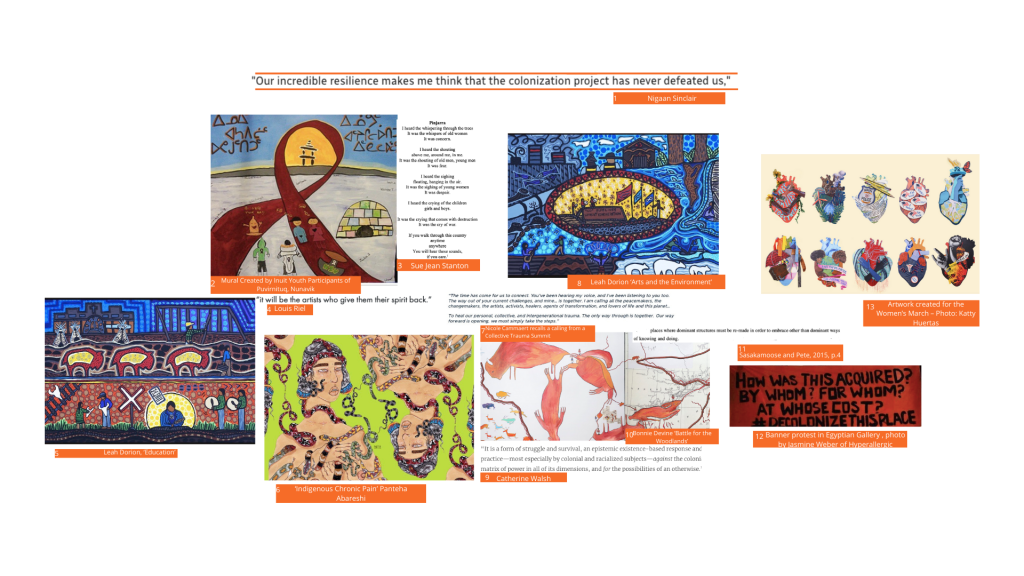
(1) Monkman, L. (2018, avril 7). What does decolonization mean? Our panel debates the buzzword
https://www.cbc.ca/news/indigenous/panel-debate-decolonization-meaning-1.4609263
Niigaan Sinclair is an Anishinaabe assistant professor and head of department of Native Studies at the University of Manitoba
(2) Flicker, S., Danforth, J. Y., Wilson, C., Oliver, V., Larkin, J., Restoule, J.-P., Mitchell, C., Konsmo, E., Jackson, R., & Prentice, T. (2014). “Because we have really unique art” : Decolonizing Research
with Indigenous Youth Using the Arts. International Journal of Indigenous Health, 10(1), Article
1. https://doi.org/10.18357/ijih.101201513271
A project was carried to create art workshops with Indigenous Youth, a study from arah Flicker, Jessica Yee Danforth, Ciann Wilson, Vanessa Oliver, June Larkin, Jean-Paul Restoule, Claudia Mitchell, Erin Konsmo, Randy Jackson, Tracey Prentice
(3) Manathunga, C., Davidow, S., Williams, P., Gilbey, K., Bunda, T., Raciti, M., & Stanton, S. (2020).
Decolonisation through Poetry : Building First Nations’ Voice and Promoting Truth-Telling.
Education as Change, 24. https://doi.org/10.25159/1947-9417/7765
Sue Jean Stanton is a Kungaran-Gurindji scholar born in the Larrakia Country, Darwin, Australia
(4) Louis Riel | l’Encyclopédie Canadienne. https://www.thecanadianencyclopedia.ca/fr/article/louis-riel
Louis Riel a Canadian, is a leader of the Métis peoples and founder of the province of Minotoba
(5, 8) Artwork | University of Alberta.
https://www.ualberta.ca/admissions-programs/online-courses/indigenous-canada/artwork.html
Leah Dorion is a Métis artist and and educator committed to sharing the culture and history of her community, the Cumberland House Saskatchewa
(6) Delchamps, V. (2021). Rattlesnake Kinship : Indigeneity, Disability, Animality. Disability Studies
Quarterly, 41(4), Article 4. https://doi.org/10.18061/dsq.v41i4.8451
Panteha Abareshi is a Persian-Jamaican artist. In her art, she mainly portrays chronic pain and disability but touches upon many more subjects and especially in ’Indigenous Chronic Pain’. The rattlesnakes represent both the pain and power as well as the carriers of the expression of grief. She provides new meanings to the animals historically under the white American eye, creating feelings of disgust and fear.
(7) Reflections on Our Decolonization Learning Journey—IONS – Impact Organizations of Nova Scotia.
(2021, septembre 29). https://ions.ca/reflections-on-our-decolonization-learning-journey/
Nicole Cammaert is a Director of Network and Sector Development at Impact Organisations of Nova Scotia. She worked around reconciliation and decolonisation mostly through her work at the ‘Decolonization Learning Journey’
(9) Catherine Walsh. (2017, janvier 19). Essays on Global Blackness & Questions of Freedom.
Catherine Walsh is a professor and director and director of the Latin American Cultural Studies at the University of Andina Simon Bolivar in Quito, Ecuador
(10) BONNIE DEVINE’S BATTLE FOR THE WOODLANDS BATTLES THE STATUS QUO – MUSKRAT
Magazine.https://muskratmagazine.com/bonnie-devines-battle-for-the-woodlands-battles-the-sta
Bonnie Devine is a Serpent River Obijwa artist. In the famous ‘Battle for the Woodlands’ she
extends the colonial map of Canada centering the Great Lakes to depict an Ashiniwabee
worldview.
(11) Sasakamoose, J., & Pete, S. M. (2015). Towards Indigenizing University Policy. Education Matters:
The Journal of Teaching and Learning, 3(1), Article 1.
https://journalhosting.ucalgary.ca/index.php/em/article/view/62922
Excerpt from a paper of Indigenous scholars JoLee Sasakamoose and Shauneen Pete that aimed to explore the challenges linked to indigenizing Canadian universities
(12) What is decolonization ? —Community-Based Global Learning Collaborative.
https://www.cbglcollab.org/what-is-decolonization-why-is-it-important
Decolonize this place activists in the Egyptian Galleries of the Brooklyn Museum
(13) Decolonizing Art. (2019, mars 15). The Interfaith Observer.
http://www.theinterfaithobserver.org/journal-articles/2019/3/12/decolonizing-art
Anonymous artist
 Stolen Lives