Feeling of Pride / Resistance
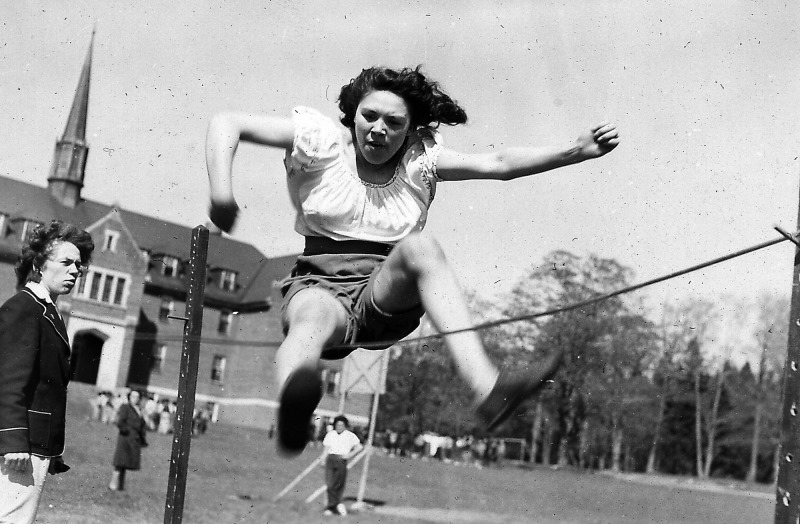
Former students of the boarding schools often have positive recollections of the sports activities. Ex-students describe how sports formed a complex cultural practice that allowed Native Americans to express their identities in new ways and feel pride in their culture, all while allowing them to overcome an insensitive educational system.
Many students discovered a means to resist school officials partly through their membership in the band and athletic teams, vital elements of the school’s marketing campaign. Membership in the band and athletic programs provided respite from tedious school routines, and also helped improve the self-esteem of students. More importantly, these activities provided Indian students with the opportunity to demonstrate Indian ability in an era clouded by racism. Through sports, Native American students had the opportunity to reinterpret and express their cultural heritage, customs, and sense of self.
Successful athletes and impact today
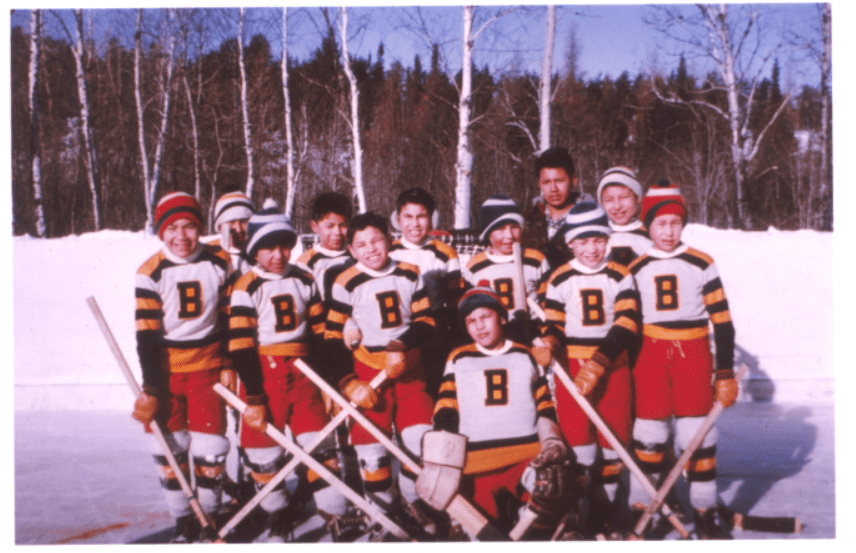
Some residential schools were able to develop rather outstanding athletic programs, which led to some of the students being able to move onto professional sports careers or compete in elite-level amateur sport after they finished residential school.
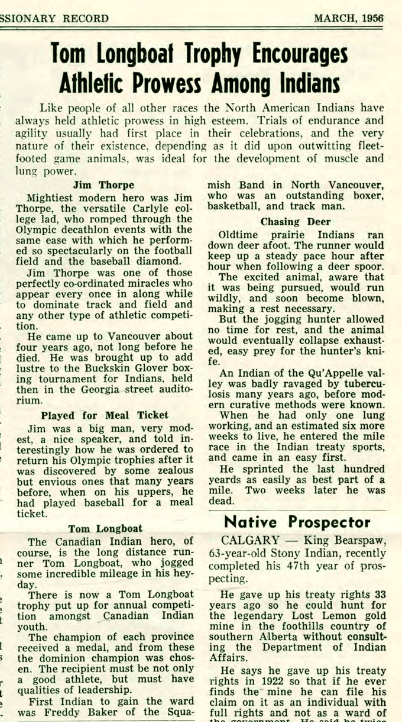
The Tom Longboat Awards was established in 1951, and given to Native/Aboriginal athletes to recognize their outstanding contributions to sport in Canada. Tom Longboat was a very successful long-distance runner, who had attended the Mohawk Institute Residential School, and later became one of the most famous Canadian athletes. However, the Awards were also used as an encouragement for Indigenous assimilation through organized sports. While it was in the hands of the government at first, it has been managed and presented by the Aboriginal Sport Circle since 1999, where it now stands as a proud emblem of Indigenous self-determination.
Janice Forsyth investigated the Tom Longboat Awards, and interviewed several recipients to understand what it means to them. Some relevant aspects that arose from those interviews, are the legacies that residential schools have in sport, and also how racism and sexism in society plays a large role in who gets access to opportunities. Indigenous children who played sports at residential schools, often had to put in their own efforts to construct facilities and create opportunities for themselves. Through this, they were sometimes able to continue playing sports in professional leagues, but in no way thanks to those who ran the residential schools. On top of this, Indigenous children faced many boundaries and challenges to take part in sports, for example due to simple logistics of living on a reserve and being far away from facilities or extracurricular programs. Those who did manage to get an opportunity in a bigger city and play on a team, often faced a lot of racism and were used for commercial profit. Because they were seen as “different” from other athletes, they were objectified and used by their teams and the media to gain attention and profit off of them. Forsyth concluded that the Tom Longboat Awards have not been able to shift the perspective Canadians have of Indigenous people and athletes, because the organizers are the ones who control the narrative that is attached to the Awards. The individual stories of recipients are silenced, which leads to ignoring the many complexities that come with being an Indigenous athlete.
Media for promotion
Using images is a solid method to influence how we view historical events. When discussing sports at residential schools, it is essential to note that photographic images were intentionally created and thoughtfully chosen. Portrayals of joyful children playing at Indian residential schools have been utilized to support the idea of sports as a positive influence, overlooking the circumstances surrounding the creation of these images. Some people only have pictures of their sports teams from their time in boarding school.
Enlarging the school’s credibility was meant to garner political support in order to ensure the school’s survival, and was understandable since Indian boarding schools were dependent on public support. Not surprisingly, administrators at residential schools sought to publicize the school’s ability to assimilate Indians, and its success in transforming them into civilized human beings. As a result, school officials developed a marketing strategy that focused on Indian children who had seemingly adapted to the dominant culture. These events featured Indian children competing against all-white athletic teams.
Research indicates that media coverage of sports primarily highlighted the successful assimilation process of Indians. Some researchers argue that the media had the opposite effect. They contend that despite their enormous success, Native American school athletes accomplished little to benefit Native Americans themselves, other than to further the stereotype of them as racially defined, animalistic, and solely physical people in the eyes of the media.
References
Aboriginal peoples and sport in Canada: historical foundations and contemporary issues. (2013). Choice Reviews Online, 50(11), 50–6243. https://doi.org/10.5860/choice.50-6243
Aboriginal Sport Circle announces the 2023 Tom Longboat Awards Recipients. (n.d.). Aboriginal Sport Circle. https://www.aboriginalsportcircle.ca/news_details.php?id=36
Are Females more competitive than cooperative : an investigation into gender differences | Algoma University Archives. (n.d.). http://archives.algomau.ca/main/?q=node/27952
Bloom, J. (n.d.). “Show What an Indian Can Do”: Sports, Memory, and Ethnic Identity at Federal Indian Boarding Schools.https://eric.ed.gov/?id=EJ543431
Forde, S. (2021). Reclaiming Tom Longboat: Indigenous self-determination in Canadian sport. Annals of Leisure Research, 24(1), 189–191. https://doi.org/10.1080/11745398.2021.1880947
King, C. R. (2006). Introduction: Other Peoples’ Games: Indigenous Peoples and Sport in North America. International Journal of the History of Sport, 23(2), 131–137. https://doi.org/10.1080/09523360500478174
McKee, T., & Forsyth, J. (2019). Witnessing Painful Pasts: Understanding Images of Sports at Canadian Indian Residential Schools. Journal of Sport History, 46(2), 175–188. https://doi.org/10.5406/jsporthistory.46.2.0175
Oscar Medina, W. (2007). Selling Indians at Sherman Institute, 1902–1922 [PhD Dissertation, University of California Riverside]. https://www.proquest.com/openview/211be019d5031db32d6983aa30d33d65/1?pq-origsite=gscholar&cbl=18750
Tom Longboat | History. (n.d.). Tom Longboat. http://www.tomlongboat.ca/history.html
Tom Longboat Awards. (n.d.). Aboriginal Sport Circle. https://www.aboriginalsportcircle.ca/tom-longboat-awards
 Stolen Lives
Leave a comment