The First Day
Each story is different, and each testimony can depict different nuances. However, it is a common experience for many survivors that the first day was full of confusion and hostility. Schools would have been imposing, strange, and foreign for the children to come to, especially since many would have been forcibly removed from their families. A survivor recalls how her parents had informed her she would be attending school, but ‘school had no meaning to [her], [she] was only seven years old’. She also recalls ‘the screaming and crying starting’, as well as ‘children kicking and waving their arms as they tried to struggle free’. Another testimony recalls ‘the sterility of the hallways’.
Gender segregation
An important aspect that played a large role in the shaping of the children’s daily lives was gender segregation. Already before the Indian Residential School system began forcibly removing children from their families, the Indian Act created and sustained inequalities between men and women. The Indian Residential School system was one of the colonization strategies to intellectually, emotionally, and spiritually engrave patriarchal values into Indigenous children, which removed Indigenous women’s traditional agency and role within both Indigenous communities and the larger society.
These practices can be clearly seen in the structure of the daily lives of children who attended Residential Schools. One way this is seen is in the division of tasks and duties that children were forced to do. One part of the day was devoted to academic education, but the other half, the children would be forced to do labor that ‘suits their gender’. As can be seen in the Shingwauk Manual, “the rougher outdoor work naturally falls to the boys, and the older ones under the supervision of practical foremen are taught farming and carpentry (Figure 1). The girls share in common with the boys the day schools, and in addition are taught sewing, domestic, and laundry work (Figure 2).” The boys were forced to do menial work related to agriculture, and the girls were trained to be domestic slaves. A survivor stated that she “didn’t learn too much except how to be a maid”.
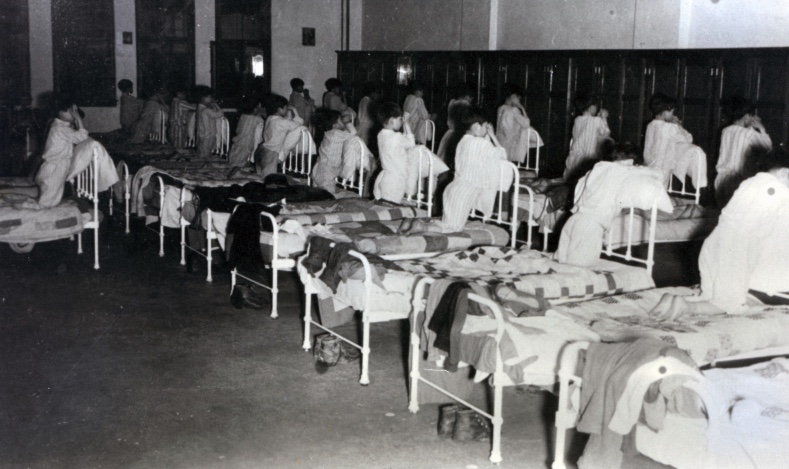
Not only this, but, as soon as the children arrived, they were separated by sex, and were not allowed to interact with the opposite sex. Already handling the pain of being forcibly taken away from their families, this segregation made it even more difficult for those children who had the possibility to find some comfort in communicating with siblings, but even this was strictly forbidden, and the children were punished even for the most minor interactions. A survivor, Joe Courtoreille, recalls “I wasn’t allowed to talk to my sisters, even if we were in the same class. We’d have to pass notes”. If boys and girls would get caught interacting, they would endure punishment. A survivor, Dorene Bernard, recalls how she passed her brother in a corridor, and a staff member threw her brother against a radiator for saying ‘hi’ to her. Girls and boys were separated in the dorms, with the girls’ and boys’ dorms usually being on different floors, they were separated during meals, where girls were placed on one side of the room and boys on the other, and in the play yard, which divided the boys and girls with a fence.
These gender divisions not only impacted the children during their time at the Residential Schools, but also left long-lasting consequences on their lives in the future, and social connections with others. For girls, the Residential School experience left difficulties within parenting skills and Indigenous childbearing practices, and the boys were indoctrinated to exert power through control and violence, which manifests in the futures of their family lives. Survivor Michael Cachagee states that, since a lot of the abuse was perpetrated by nuns at the schools, as an adult, he did not know how to treat women, stating that he was “married at 18 and didn’t have a clue on how to be a husband or father”. The difficulties with violence and neglect now seen in some Indigenous families is a direct consequence of the conditions of Residential Schools, which completely destroyed the traditionally loving and nurturing family conditions.

Figure 1: boys doing farming. http://archives.algomau.ca/main/?q=node/45097

Figure 2: girls doing laundry. http://archives.algomau.ca/main/?q=node/16028
Age segregation
Age segregation was another tool to keep children away from any connection to their cultures. The goal was to assimilate Indigenous children to Western culture as soon as possible. Shingwauk Residential School survivor Susie Jones, who was placed at the age of 4 and a half, recalls that “the law was that children went at 6, but the premise was to assimilate the children, to brainwash them into the European way, and the best way to do that was to get the children at an early age. They would fudge our age on the paperwork to make it look as though they were obeying the law.” This can also be seen in the case of a survivor named Ernie, who was forcibly placed in a Residential School at the age of just ten months. When he first arrived, he was given the highest number, 59, because he was the youngest, and he gradually went down to 32, showing the inhumane ways the children were rendered invisible, and made to be just numbers at the Residential Schools.
Just like gender segregation, the dorms were separated by age, which meant that many times, even if siblings were of the same gender, they would still be separated because of age differences. Survivor Janice Acoose recalls being separated from her older sisters because they were divided into small-girls and big-girls dorms. A similar experience is described by survivor Allan, who gave a detailed description of the separation of the boys’ dorm: “So from age five, I was with the smallest kids in that dorm. It was one great big giant dorm for the junior boys.
Not only did the Residential School system physically divide the children, but age division also manifested within the groups of children, where many survivors recall the younger children being bullied and beaten by the older ones, and some even recall younger children being molested by older children, and all of this was tolerated by the staff who did not care about the children’s well being. These experiences also reflect the cycles of abuse, and that the behaviors children exerted towards other children are not in any way natural, but learned from the ways children were abused by staff members.
Discipline
Life at residential schools was as regimented as a prison or army base is today. Children were often called by their number, which was put into their clothing and utensils. The children’s culture and language was not tolerated, it was replaced with strict morality and unyielding discipline. Through discipline, the children’s voices were silenced – not allowed to speak unless spoken to, not allowed to have an opinion, and creativity was discouraged. They marched and lined up, all in silence. This way of life, aiming to convert the children into mere numbers, was just another element of the scheme of cultural erasure.
A Colonial Diet: Food, Hunger, and Health
Food is very important to daily life because it is what directly impacts the rest of your day – it sustains you. Figure 3 shows a typical menu at Shingwauk, where there is a clear prevalence of potato, sugar, and flour, and a limited access to fruit and vegetables. The children also had limited access to protein and fat. The core of the issue is this is a colonial diet, very different to the pre colonial indigenous diet best adapted through centuries of knowledge to the environment, and the health of its peoples. Another key element of this diet, as seen through testimonies, is the lack of it – hunger was very prevalent at residential schools. Large periods of hunger during childhood have been shown to have deep biological effects on growth, such as height stunting and higher propensity to obesity later on in life.
In addition, food is not just caloric intake. There are physical, symbolic, spiritual, and family relationships around food that deeply affect children’s growth and development that the residential school diet stripped away from them. Current research describes how this legacy of negative relationships with food that was instilled at residential schools now manifests itself in the form of high prevalence of illnesses such as diabetes or cancer among indigenous populations.

Figure 3: A typical menu at Shingwauk Residential School. http://archives.algomau.ca/main/sites/default/files/2014-020_001_003_1895.pdf
Religion
Religion also intrinsically affected the daily lives of children at residential schools. Not only was it a daily part of life in the frequent, strict prayer, but it was a tool for indoctrination, and, for many survivors, a source of confusion, and despair. Prayer was the number one thing, drilled into children’s lives, but without intention, without explanation, or without meaning. Children were imposed teachings that seemed to contradict everything they understood, the meaning for everything they did at residential schools did not represent anything they brought from the reserve. Concepts of punishment, hell, and damnation, without explanation or context, instilled fear and confusion, and religion became something associated with punishment or evil. The imposition of this Western view of the world and of spirituality came hand in hand with a cultural erasure of indigenous ways of being, which are so crucial for the upbringing of indigenous children. The residential school aim of cultural assimilation is inseparable from religious conversion because myths, memories, and practices associated with religion are always entangled with other aspects of culture. The impacts of this can still be seen on the daily lives of survivors and their descendants today since it left the children unprepared for life after schools (Figure 4).

Figure 4: Survivor’s quote. http://archives.algomau.ca/main/sites/default/files/2015-054_001_003.pdf
Education
The children at residential schools were taught reading, arithmetic, writing, and religion. Schooling meant basic literacy and practical skills: there was school in the morning and chores in the evening, divided by gender. But, what schooling also meant was the replacement of ‘the First Nations’ tribal and communal values with capitalist values’. This ‘education’ that the residential schools aimed to give to the children was intrinsically Western, containing a philosophy ‘diametrically opposed to the traditional Indian philosophy of education’. What the children were truly being taught, behind the western math, literature and religion, was to ‘despise their cultures and languages’, and to reverse the effects of these teachings today requires an active communal effort of decolonization to unlearn these dominant narratives and relearn different ways of living and being.
.
 Stolen Lives